
Posted by Annika Landis, EnjoyWinter-NTS Factory Team Athlete on Jun 12th 2026
How I’m Preparing for a June Ultra Marathon
On June 20th, I will be racing the River of No Return 55k in Challis, Idaho. This will be my first race of the summer, and I’m fine tuning my final preparation as race week approaches. Ultrarunning has been getting a lot of hype in the past few years, and there is SO MUCH information on how to train, how to eat, how to sleep, and on and on. It can be overwhelming to figure out how to approach it best, so I’m trying to keep it as simple as possible and focus on the basics. At the end of the day, the basics are what get you from point A to point B, and everything else is focused on trying to improve at the top margins.
So how am I preparing for this first race?
Base Prep:
My running season got off to a slow start, mainly because my last ski race was mid-April and when I got back, there was still enough backcountry skiing to be had that I couldn’t be bothered to get the running shoes out. Plus, I had pulled my quad stepping into a ditch trying to watch the northern lights in Iceland, so I was letting that heal up a bit. Whoops.


photos by Peter Wolter
Once I was done skiing, and back from co-leading a Community School backpacking trip in Southern Utah, it was time to get serious about getting some miles in my legs. But, obviously it’s not smart to jump directly into some big mileage, and so my focus was “time on feet.”
The most important aspect of my prep is just getting time on my feet in my running shoes. Just easy miles to get my body readapted to the impact and biomechanics of running. Even if it is just a 20 min jog before strength, or after a bike ride, keeping high frequency (but not necessarily high mileage) has been a great way to get my legs feeling ready for some more specific and longer training sessions. And I’ve been pairing that with an emphasis on injury prevention and strengthening.


the past two weeks have been incredibly beautiful!
Strengthening:
One thing that can help prep your legs for running while still keeping the mileage low is heading into the gym for some strength. Trail running requires strength and agility, and ultrarunning requires intense muscular endurance.
I focus on two main things in the gym for myself: strengthening my core to support my back, and strengthening the muscles in my legs that support my knees and provide dynamic agility and power crucial for trail running.
At this point in the summer, I am not cranking out heavy lifts - but rather focusing on the basics, which can be just as hard if you’re doing it right. I do a lot of banded work, isometric holds, and basic plyometrics, mixed into a general full body strength routine. I focus specifically on my glute medius, Adductors & Abdutors, quads, soleus and static & dynamic core. I really like doing single leg exercises, because it exposes imbalances and forces the right muscle to do the work.
I cannot emphasize enough how important it is to maintain a strength routine throughout the year. Especially for high impact sports like running, you need to keep all your big muscles and connective tissues strong so that they can support your training and you don’t get injured. I learned this the hard way, and trust me, prevention is way easier than rehab.
Adding Intensity and Distance:
After a few weeks of easy miles, I started to add in some intensity and distance. I’ve actually only done three intensity sessions on foot so far. This is because intensity is well, more intense, and I wanted to prioritize increasing mileage and durability over speed. I didn’t have time to do both, and I know for a long race, durability outweighs speed. The build for this race is more condensed than is recommended, so I only got in one “big” run capping out at 19 miles. But the closer I get to race week, the more confident I feel that my legs will be able to carry me 34 miles.


My longest training run was to support my sister, who race her first Ultra at Scout Mountain 60k this past weekend! She absolutely crushed it and it was so fun to watch.
Practicing Nutrition and Hydration for Race Day
Through all of this prep, I have been fueling as close to my race day strategy as possible. I’ve had stomach issues in past races, and this is an aspect of ultrarunning that I am really trying to dial in this summer. For every running session, I have grudgingly left behind more palatable snacks in favor of the gels (Maurten, Precision Fuel, and SIS) that I will actually be using during the race. Even for a short 4x4 min intensity session, I will load up my stomach with gels to practice racing hard while eating. While that did result in a very uncomfortable and unplanned walk home the other day, I learned where that limit is, which is very valuable information. We should train how we race, and that includes fueling!

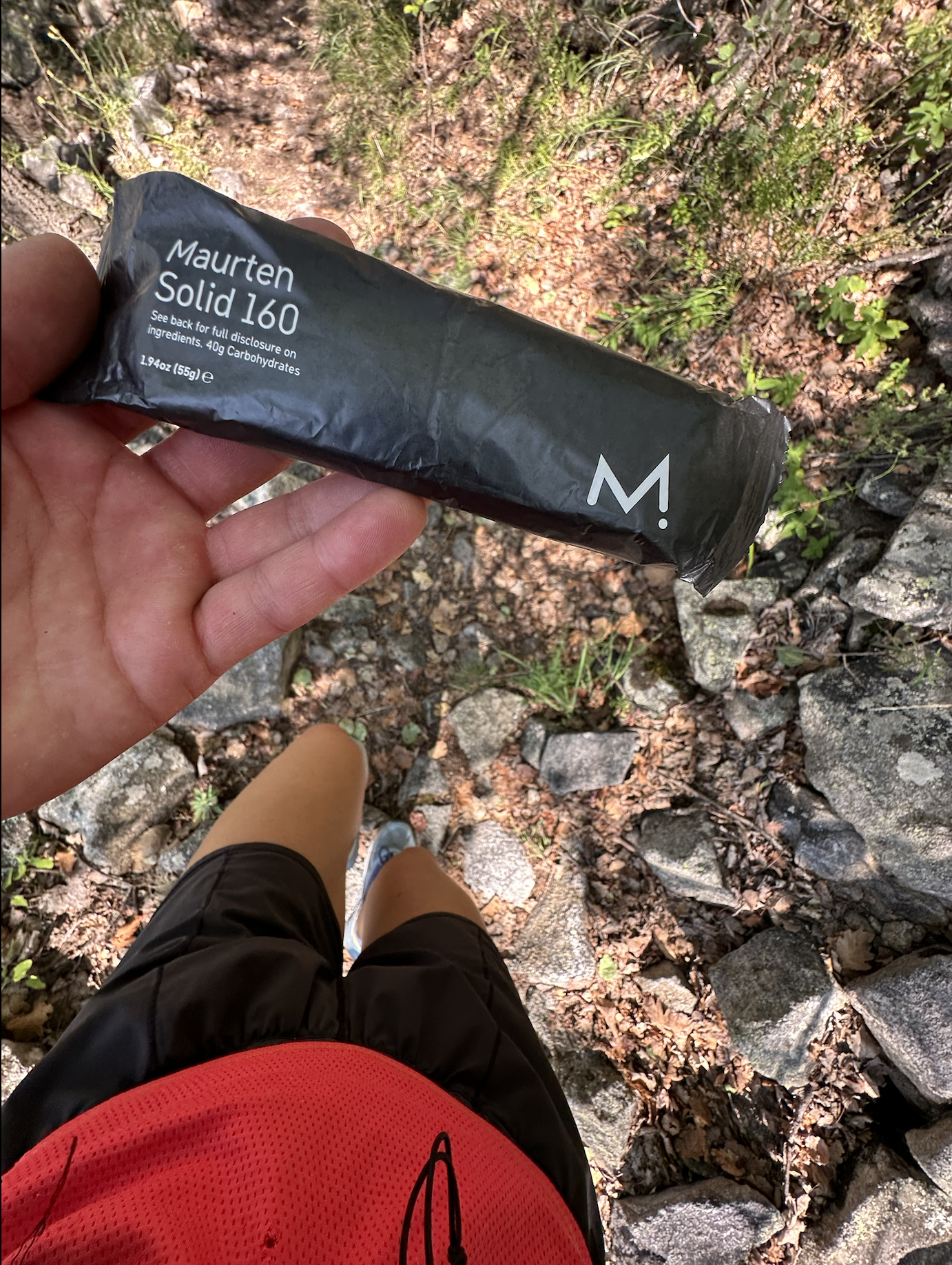
Carbs? or Carbs?
Heat Training:
Lastly, this race in Challis has the potential to be much hotter than I am adapted to at this point in the spring. To prepare my body for this, I have been heading to the sauna 3-4 times a week for a 30 minute heat session. Very simply, heat training triggers physiological adaptations that allows you to better regulate body temperature (by starting sweating sooner), increases your cardiovascular efficiency, and increases blood plasma volume. I also find it is a great way to mentally adapt to feeling uncomfortably hot, so that you aren’t encountering this feeling for the first time on race day.

If you don’t have access to a sauna, you can still help your body get adjusted to training in the heat by wearing extra clothes when you exercise. General recommendation is to still wear breathable layers (not going for the impermeable trashbag look) so that you get hot, but can still wick sweat. We’re not trying to sous vide ourselves, rather to increase our cardiovascular and sweating efficiency through small adaptations over time. I actually like this method a lot for a few reasons: (1) It better simulates how you will actually feel racing while hot (2) It provides an opportunity to practice eating and drinking while uncomfortably hot
There are a few things you need to be careful about when heat training so that it actually benefits you instead of draining you. Check out this Great Article on Heat Training for more in-depth information on the best way to approach heat training as a novice.
Submit to Uncertainty
The last phase of prep for me is submitting to the uncertainty of race day. I can never fully predict how my body will feel at mile 32, or if I will feel nauseous at mile 14 or if I will feel fantastic all day. Uncertainty is an inherent part of racing that I try to account for by preparing well in every other way, big and small, mentally and physically, in the lead up to the event. That way, when I get to the start line and things inevitably go differently than I planned, I have the foundations and the mental agility to adapt.
All in all, I am very excited to get my summer race season started, and what better way to kick it off than the furthest distance I’ve ever raced, close to home, followed by a Father’s Day brunch?