
Posted by Jack Young: EnjoyWinter Athlete Force, Team USA on Oct 16th 2026
Why I Don't Use the Whoop Recovery Score
Over the past decade or so, Heart Rate Variability (HRV) has become a popular biometric for endurance athletes to track using wearables like Whoop, Oura ring, or most sport watches that include wrist based heart rate. I have had a Whoop membership for 4 years at this point, and although HRV is a flashy metric that is the cornerstone of their recovery formula, I have found more value in the simpler biometric data that my whoop provides such as Resting Heart Rate (RHR) and sleep duration. It is not that I don’t use HRV at all–I do in specific ways unrelated to day to day training readiness–it is more that I take issue with the red, yellow and green scale of recovery that whoop and other wearables use. In this post, I hope to explain what these metrics are and how I actually use them as a somewhat high-performing endurance athlete.
What is HRV?
This question is more complex than initially meets the eye. The textbook definition of HRV is the difference in time between heart beats during a full breathing cycle. As you breathe in, your heart rate speeds up, and as you breathe out, your heart rate slows down. Hypothetically, when your autonomous nervous system is happy (recovered), your HRV will be higher. When you are stressed or tired, on paper, your HRV should be lower. The first complexity of this measurement is that it matters when it is taken. HRV will fluctuate wildly during a night of sleep (when most wearables track it), so it matters whether your device is measuring a certain “snapshot” of your sleep or simply taking an average of the whole night. Whoop claims to measure HRV during your “deepest sleep” during the night. For the sake of my sanity, I pretend that this is a precise enough method of collecting the data. Although Whoop includes factors such as sleep time, breath rate, and resting heart rate in their recovery formula, the biggest influence is HRV. When your HRV is high, your recovery score will be high, and when your HRV is low, your recovery score will be low.
What have I learned about HRV at a personal level?
The most important lesson I have learned in the four years of wearing a whoop is that it makes zero sense to base your training on HRV or recovery score. The best example I can provide of this is that my HRV is always low after I take a rest day. After a day off, I usually feel rested, and the intensity sessions I do after rest days usually go pretty well. If I were to plan my training around HRV, I would probably never do an intensity session the day after an off day–something that goes directly against the evidence I have gathered of feeling quite good after off days.
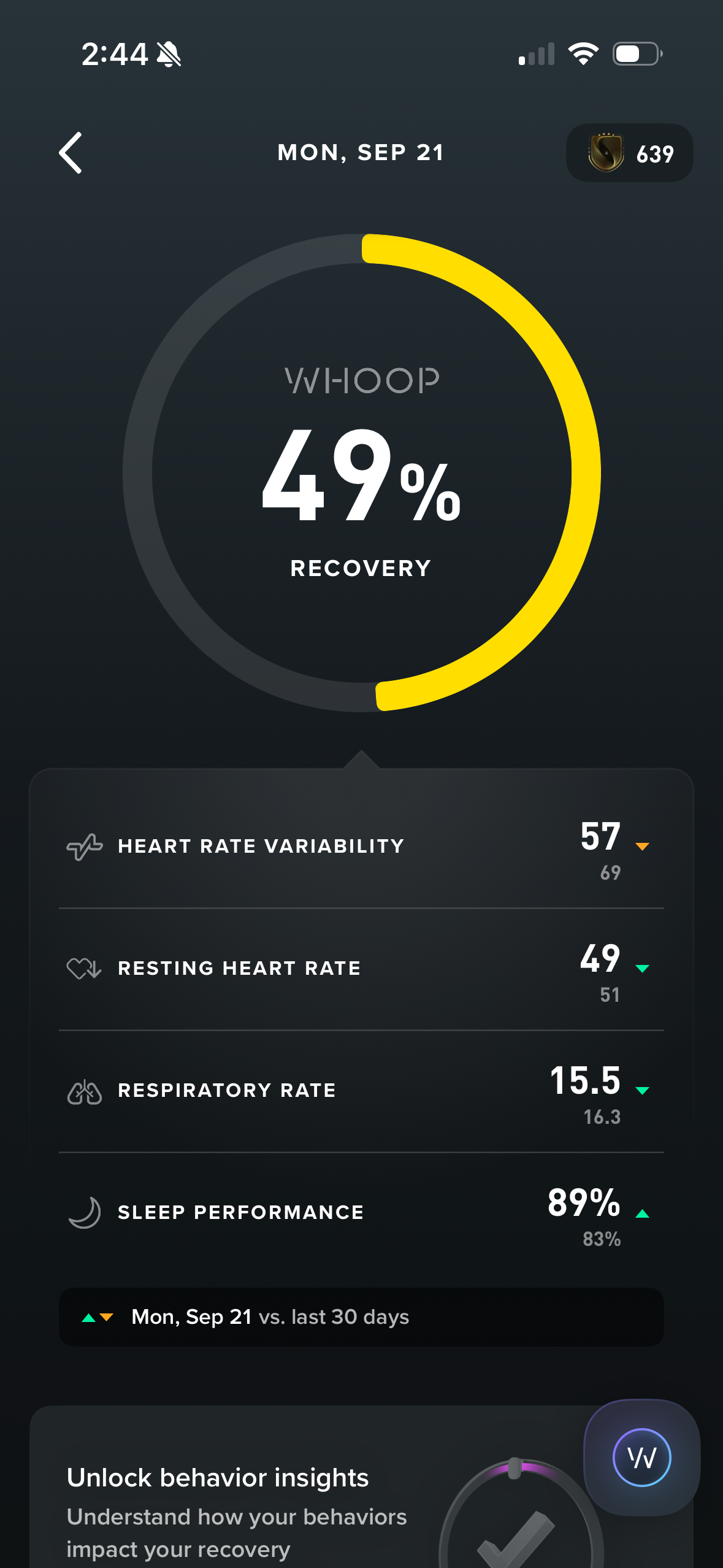
My recovery score after a day off this year.
The second trend I have noticed about my HRV is that it gets higher the more I train. I don’t mean this at the macro level, I mean this as my HRV is usually very high the day after I train 4+ hours. If I were to use the Whoop recovery score to plan training, this trend would lead me to believe that training for 4+ hours the day before an intensity session would be a good practice. Again, I have gathered plenty of evidence through monitoring my feelings while training that this is not something I should start doing.
This is not to say that HRV is useless. I do use the biometric a bit to measure training and recovery–it just doesn’t have anything to do with the recovery score. I’ll get into real applications after I talk a bit about resting heart rate.
What have I learned about RHR?
Resting heart rate is by far my favorite recovery metric. It is a very simple measure that anyone can take in the morning if they want to. Whoop, again uses an average heart rate during deep sleep to calculate the value, but I don’t have any problem trusting this to be accurate. I have tested this out, and the Whoop value usually matches up with a manual measurement taken in the morning.
Since I am at an altitude camp in Park City right now, it feels only fitting to talk about how well RHR correlates with altitude adaptation. At this point in my career, I have done a lot of trips to and from altitude, and the day that my RHR returns to normal is very often the day I start to feel like myself again training. Additionally, once I am somewhat acclimated, it is clearly reflected in my RHR when I push a little bit too hard in the secondary acclimation stage from about 3-10 days into a camp. Even if my RHR drops to normal after 3 nights, it will be quite temperamental for most of the camp and spike easily if the training becomes too intense. This is a great indicator of when to take an easier day.
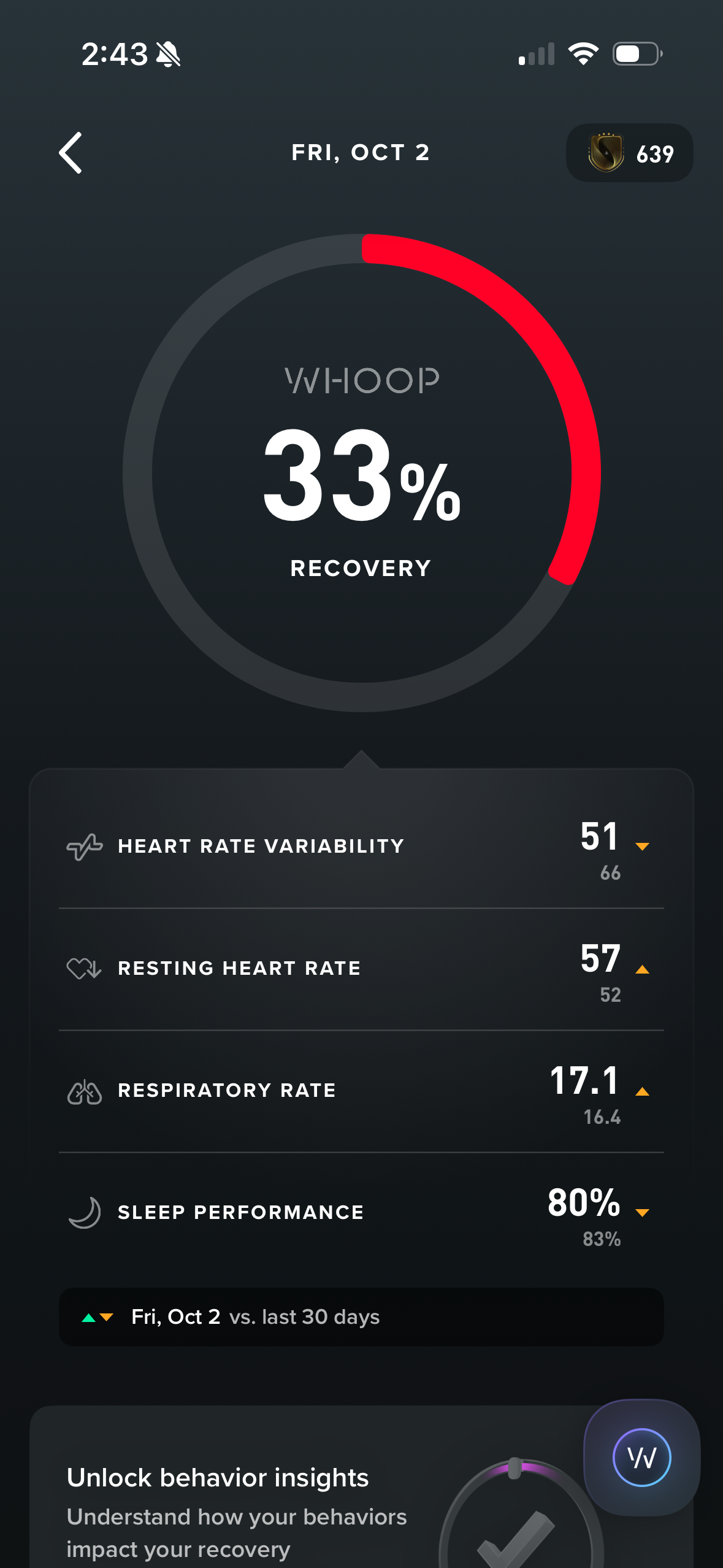
My recovery score the first day at altitude a couple weeks ago
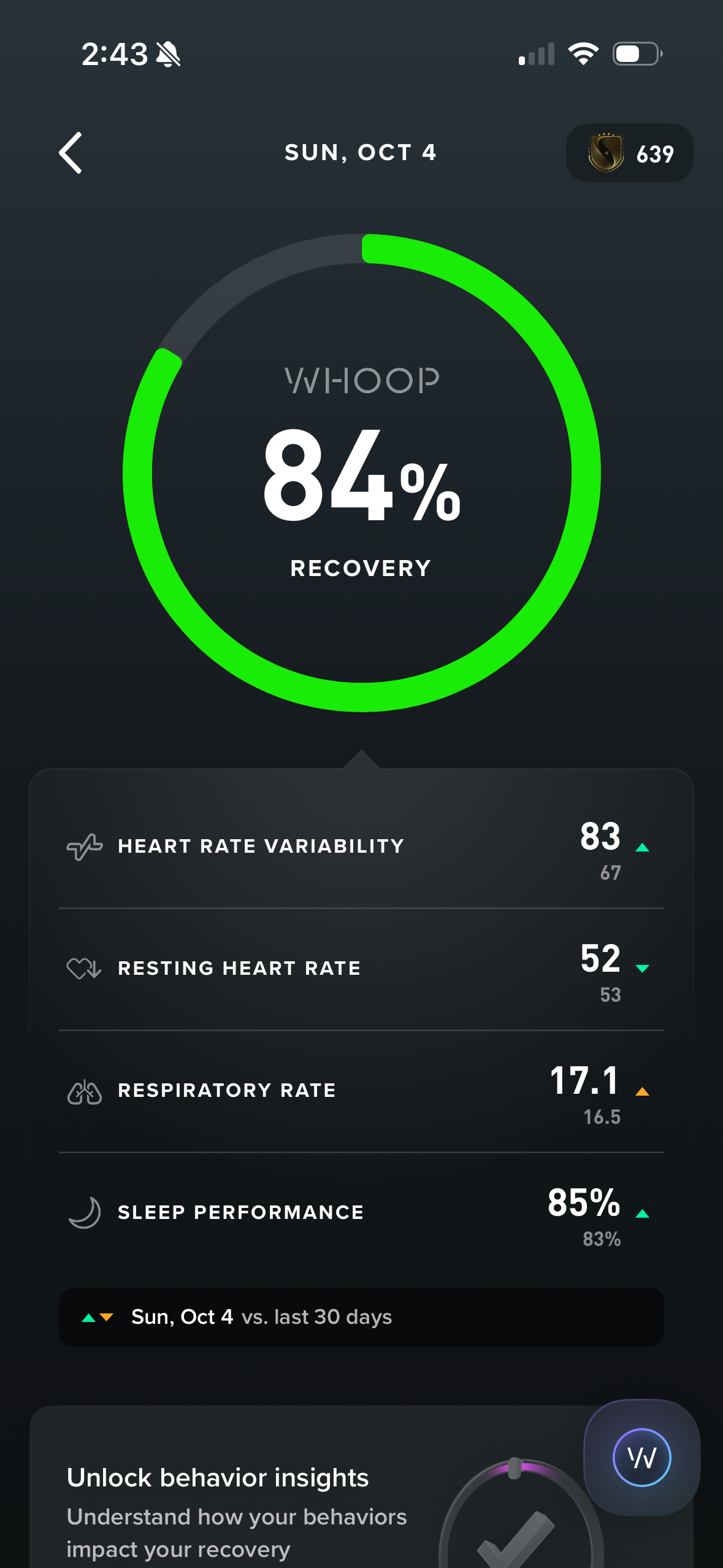
My recovery screen on my third morning at altitude
Even when I’m not training at altitude, RHR can be a great indicator of recovery problems. It is very rare that I will get a high RHR reading and feel like I am not 100% healthy or recovered when I wake up. This is especially apparent for mild sickness such as the common cold. It is normal to occasionally have a runny nose from allergies or a change in the seasons, but this accompanied by a high RHR becomes a red flag.
One thing I have learned personally about my RHR that I don’t think is talked about nearly enough is how it drops when I am not eating enough. I have always tried my best to stay on top of fueling and eating when I am hungry, but I am not perfect, and I have had plenty of nights when I woke up hungry knowing that I didn’t eat enough the night before. These feelings commonly go in tandem with a low RHR. This is very important because endurance athletes in general have low resting heart rates and are excited when they are even lower than usual. A big drop in RHR can come as a result of REDS (Relative Energy Deficiency Syndrome), so all endurance athletes should pay attention to these trends and know that a decline in RHR does not always indicate fitness.
How has having a whoop impacted my recovery and training?
One of the most popular biometrics that whoop puts out is sleep time. On a day to day level, I do not care how much my whoop says I sleep. However, I care quite a bit how much sleep I am getting on average. This is one of the biggest impacts that whoop had on my recovery back when I started wearing the device in college. I bought my first whoop subscription when I was a sophomore in college. I had never really tracked my sleep before and was going to bed whenever I wanted to and just waking up in time for morning training or class. When I started getting the sleep data, it motivated me to both sleep more and be more consistent with my sleep cycle. As a result, I started feeling better in school and training, and since my sophomore fall, I feel like the amount I sleep and how consistent my bedtime and wake times are is one of my biggest strengths as an athlete.
Coming back to RHR, in the past 4 years I have learned that lower is not always better and a normal or slightly high RHR is better than an extremely low value. I use RHR to track acclimation, an excess of training stress, sickness, and if I’m not fueling enough.
Finally, to circle back around to HRV, I would love to use the recovery score to plan training for the day, but for me this system simply doesn’t work. Instead, I use HRV to look at trends over time. A significant downward trend is sometimes a cause for concern, but it could also just mean I am losing some training fitness during the 4 month long race season (not a bad thing). A steady upward trend during this summer is good, but a string of extremely high measurements probably doesn’t mean I got a lot fitter overnight.
This brings me into my final and possibly most important takeaway from tracking these biometrics for the past four years: outliers in either direction are almost always cause for concern. With the hype around using wearables to track recovery in the past decades, I think the limitations of these devices have been overlooked. As I have tried to train more over the years and do so more efficiently, I have stopped looking so much at each day on its own–this goes for both training and recovery. Because of this, I want everyday to be as normal as possible. It’s anecdotal evidence for sure, but in my experience, the more normal my biometric data is–whether that is RHR, HRV, sleep duration, or sleep quality–the closer it has been to average, the better I have felt. Low values can be just as much cause for concern as high values, so regardless of how your wearable bundles the data it collects into one neat recovery score, I urge all endurance athletes to look at each individual value and learn how each of those measures affect you individually.