Posted by Jack Young: EnjoyWinter Athlete Force on Sep 4th 2026
My New Favorite Sprint Workout
A couple weeks ago, I wrote about the value I see in doing sprint simulations somewhat frequently during the summer and fall. Last week, my team, the Green Racing Project (GRP), completed a sprint workout that was somewhat similar to a full sprint sim with a few big changes. The workout is far from rocket science–it consists of a qualifier and intervals afterward at the speed of the qualifier. I had proposed this workout to Pepa, then the GRP coach, two years ago, but since it required at least four coaches to time the intermediate splits needed to time the sectors, we never actually did the workout. Now, two years later we finally got it done, and I’m stoked with the results.
The Workout
As stated above, the workout starts with a standard qualifier of the classic technique at 15 second intervals. During this qualifier, we split the course into three sections with clear starts and finishes that could be timed as “sectors”. The result of this qualifier is a results sheet with not only final time, but three different sector times that show how fast each athlete skied different sections of the course.
After the qualifier, we took a long break (about an hour) to recover and refuel for the intervals to come. This long of a break isn’t always necessary, but I like long breaks after qualifiers for the simple reason that it makes the qualifier easier to do all out. If I have intervals looming soon after, I am more apt to take a percent or two off of my qualifier subconsciously to prepare for the intervals. After this hour of recovery, we started intervals on the course.
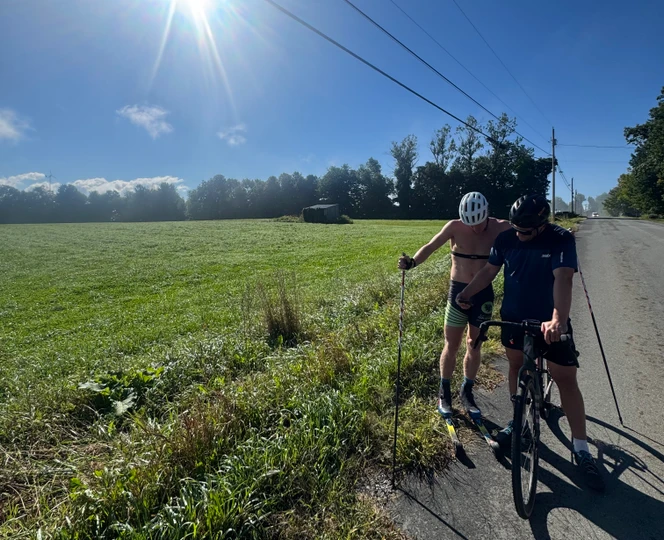
The idea behind the intervals was pretty simple: split the course into thirds, time each third during the qualifier, and repeat each sector a couple times at a slightly faster pace than I completed it during the qualifier. For this particular course, the first sector took 55 seconds (including a tucking downhill), the second sector took 70 seconds, and the final sector took 65 seconds. We planned to do 2-3 reps of each sector with about 4 minutes of rest in between each effort. We ended up doing 3 reps of the first sector individually, 2 reps of the second sector individually or in pairs, and 3 reps of the last sector in our full group of 4.
Besides the sector times, we had one other big set of data to comb through after the workout was done. Former GRP athlete, Mike Gibson, who now works for USBA let us borrow his Archinesis set which are incredibly accurate GPS devices. These wearable GPSs track each tiny difference in how each athlete skied this course. The data was fascinating to look through afterwards, but because I didn’t have access to it until the day after when we were already done with the workout, I’ll avoid expanding on this subject too much.
Takeaways
My individual takeaways from this workout are going to vary greatly from anyone trying this workout with a different sprint course and a different group of people. However, I think talking about my specific takeaways from this session can illuminate how anyone can approach trying to get better at qualifying using this session. For clarity’s sake, the workout that follows was 3x55” + 2x70” + 3x65” all with 4-5 minutes of rest.
Sector 1: Getting out of the gate
The course we used for this workout was a little different than our usual rollerski sprint course. Our usual course is pretty flat, so for this workout, we opted to start and finish in different places to make use of the biggest hill on the rollerski track. This also made it so the start of our course was only 15 seconds of work and then a long, 25 second downhill. The first sector then ended 15 seconds into the next uphill near where we were transitioning from double pole to striding. I won this sector by a second over my teammates seemingly just from having a quick start and good momentum into the first hill. My teammates used this data to try starting with an actual all-out sprint to try and shave a second or two off of their times. Although this sector was quite easy in a relative sense because of how much downhill there was, it was actually somewhat hard to execute. It was important to go absolutely as hard as possible from the gun and then settle in after the downhill into a consistent qualifier pace. Sure, all of us could have taken a couple seconds off our times by sprinting the whole sector, but that would have been cheating the workout.
Sector 2: Settling in
I lost the second sector by a second, and after seeing the Archinesis data afterwards it seems like it was just a slow bleed the entire time up the large climb where I just wasn’t double poling or striding as fast as my teammate John was. According to the Archinesis data, I lost 2 seconds over the span of just a 30 second climb. Just not having enough power is more of a training/fitness issue than a technical one, but knowing that I lost time in this sector was at least a good opportunity to try to go faster. And go faster than I did, I completed 2 reps: 2 seconds and 1 second faster than the winning time set by John. Of course, this is easy enough to do when rested, but over the past 3 years of specifically training for qualifiers, moving at a pace that is actually representative of a fast qualifier, is invaluable experience no matter how easy it is to accomplish.
During the first sector, all four of us went alone, but in this sector where draft was less of a factor, John and Jack C followed me and John respectively to quicken their pace. The point is that it’s not necessarily crucial to do all of these alone. If following someone is the way that you can stack up time at the pace you want to train at, that is probably good. However, if one of your weaknesses is finding the correct pace when you are alone during a qualifier, this is a good time to keep grinding it out alone.
Sector 3: Finish
On the other hand, the last minute of a qualifier should never be the problem pacing-wise. In my experience, it's always been pretty easy for me to just pin my ears back and go at the end. Additionally, if this is a problem for you, I don’t think doing intervals alone practicing the last minute will help–it’s probably an issue with how you’re skiing the first 2 minutes, not an issue of pacing the end.
Because of this, we started the last sector all together. We were all pretty tired at this point, but going together let us almost effortlessly ski the sector 5 seconds faster than any of us had in the qualifier. Granted, the last sector is bound to be the easiest to smash because of how tired everyone was during the actual effort, but still, the boost of physically racing against others is real. The other reason to do this together is to get a little bit of heat tactics practice in. Like I said, we were all pretty tired, which is the state that you will always be in when you are entering the finishing stretch of a sprint final. This is the best state you can possibly be in to practice tactics and the lead up and execution of a finishing sprint.
I managed to mess up all three of these intervals and got third each time. However! I got another much needed lesson in winning sprint races: you can’t just sit in the back and expect to find a way to the front. The gaps close quickest when you're in last.
Why I proposed this workout 2 years ago
Cross country skiing lacks data driven training. In a lot of other endurance sports, if you want to get really good at a race, you can just train at the state, US, or world record pace. You simply can’t do this with skiing because of the variance in snow conditions. Even rollerski speed is variable enough that it would be hard to split workouts at a “world best” time. Since we have a good idea of where our group stands in the domestic and international landscape, I think it is safe to assume that 2% faster than the fastest sector times thrown down by anyone would be at a pace that would qualify on the world cup. Is this a fair assumption? I have no clue, but I’d be willing to bet that if you take the strengths of everyone in our training group right now, you’d have a pretty darn good classic sprinter on the world stage.
Obviously, this workout doesn’t replace all of my other favorite workouts like 10x30”, 8x45” and 6x1’, but I’m excited to incorporate this one every once in a while when I can handle a workout with serious load and want to target some very specific gains in classic sprint qualifying.