
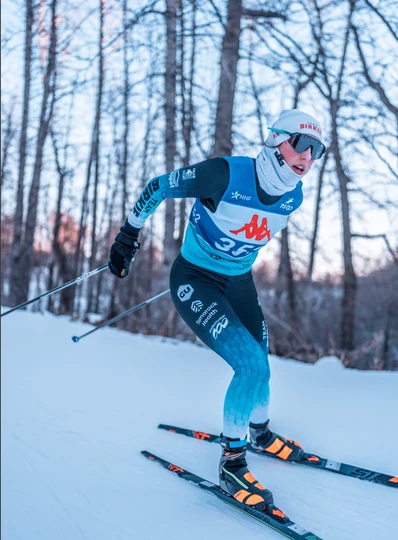
Posted by Gretta Scholz - Team SNØ on Nov 5th 2026
Listening to What Your Body is Telling You
As athletes, we ask a lot of our bodies. It’s necessary to hit high volume hours in the summer, big intensity blocks and workouts in the fall and winter, and of course long stints of regular racing throughout the winter. We have to walk a line between too much and too little to find the path to improvement. But it’s a thin line that can be hard to walk and brings up questions: How much can my body handle? What is too much volume, or too much intensity? Am I doing too little? Do I feel good enough to do more? Am I overly fatigued and getting sick? Or just tired when I should be? All of these questions require us to be very in tune with how our bodies feel and what they are telling us when things don’t feel entirely “good” or “normal.”
Sometimes it’s a short term “I overdid it last week,” and you can take extra care of your recovery and feel back to normal fairly quickly. However, this requires you to listen carefully to how you are feeling. When things don’t feel right, you have to listen. This is often something that younger athletes have a hard time with and takes time to learn. You want to do everything and want your body to be able to handle as much as you throw at it. However, there is a point for everyone where it’s too much. Waiting until you’re so fatigued that your body physically won’t do what you ask, or possibly even worse, starts breaking down is not productive. If you ignore pain and try to push through it, it almost always leads to a real injury and just gets worse. In high school, I ignored a pain in my foot for months, telling myself it wasn’t always bad and that if I was careful I could keep going and it would get better. I didn’t want to miss out on any of the races or other opportunities I had worked and trained so hard for. However, by ignoring it and not addressing that there was a real problem, I turned a treatable stress fracture into a break that would not heal by itself. Subsequently, I spent my summer on crutches and missed out on a lot more than I would have had I addressed the problem when it started.
One of the hardest things to address and get over is when something feels off or wrong, and you can’t figure out what it is or there’s no real quick path to resolving the issue. You’ve listened to what your body is telling you and have taken the necessary steps to find out what’s wrong, gone to the doctor or PT, and now you know there’s an issue. Maybe that’s Mono, Lyme disease, another long-term illness, or a chronic injury; there are things you can do to mitigate the symptoms, but all you can really do is give your body time to recover. This is particularly frustrating as the best thing for your body is rest with no particular timeline to when you may be back training and racing at the best of your ability again.
Something that is somewhat of a reserved topic, but one I think is vitally important to this conversation, is the relationship between female health and sport. Periods and other symptoms that go along with female health can be huge indicators for female athletes of how their body is holding up. Significant changes are cause for concern, even when the topic feels uncomfortable, and symptoms are not always taken seriously. Personally, I experienced some of this last winter. I was told my symptoms were likely due to my body adjusting to medication and that it was normal. But I knew what I was experiencing was definitely not normal for me, and it began to really affect my racing and overall well-being. Though it was uncomfortable, I advocated for myself, and eventually discovered I had a large fibroid that was causing my intense symptoms. Unfortunately, it’s not something that just goes away by itself, and I had to wait until the end of the season to have it surgically removed. However, listening to my body and knowing something wasn’t right even when I was told I was fine was incredibly important. Even though I couldn’t change or fix the issue right away, knowing that I wasn’t crazy and there was something wrong saved me a lot of anxiety through the latter half of the winter. I could focus on just enjoying the sport I love and trying not to dwell on the discomfort of how fatigued and out of my control my body felt.
I want to note that recognizing when your body does feel good is also hugely important. These are the times to push your body, to do the extra set of intervals or take on more volume in the week. Listening to when your body is telling you to rest, go hard, or that something is wrong are all equally significant to athletic success. The most consequential part is making sure you are paying attention to how you feel on a day-to-day basis and long-term. Sometimes, small problems do go away by themselves, but listening and advocating for yourself when something does feel wrong often puts you in a much better position than if you ignore them or just hope they resolve on their own.