
Posted by Annika Landis, EnjoyWinter-NTS Factory Team Athlete on Jan 3rd 2026
How Do I Use My Training and Recovery Data?
How to be in control of your data, and not let your data control you.
Have you ever finished a hard workout or a hard week of training, stopped your watch and looked down to see the words “unproductive” or “detraining” glaring back at you? Has this made you feel uncertain about your training plan? Ever looked at a recovery score and had it not match how you feel or been inundated by how much data is available to overanalyze?
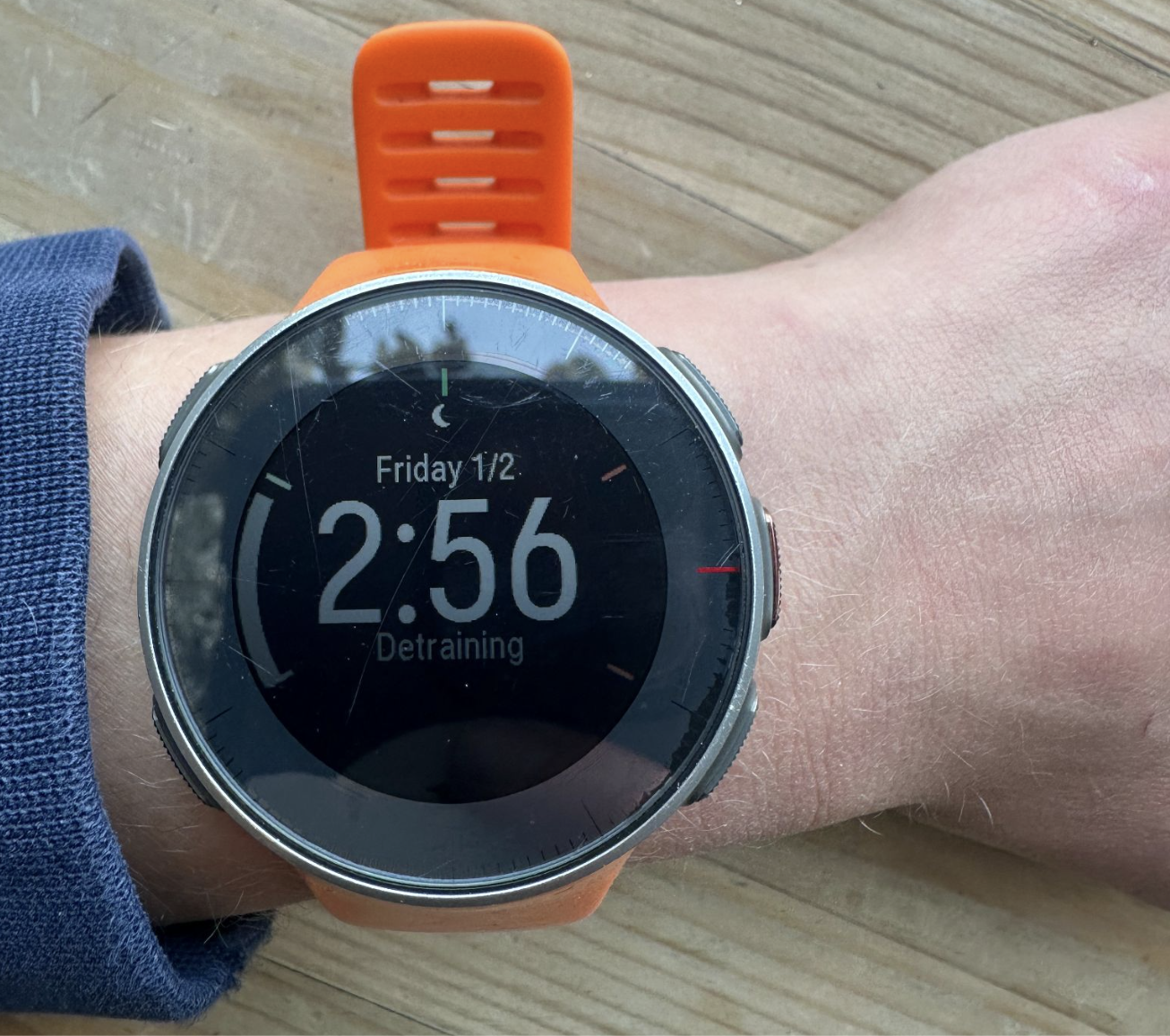

I’ve always thought using words with less negative connotations than “detraining” or “unproductive” would be a great update for all smart watches to make. Training less than usual is often intentional (tapering before a race), necessary (sickness, injury, recovery), or unavoidable (life!) and we shouldn’t feel guilty about it!
There are a lot of gadgets out there now to measure pretty much everything you can think of: heart rate, body temperature, heart rate variability, EKG, sleep stages, menstrual cycle, respiratory rate, heart rate zones, VO2 max, SPO2 (blood oxygen), calories burned, rate of aging, heart rhythm, sleep debt, sleep quality, workout strain, recommended recovery time, and on and on and on. All this data can be overwhelming and counterproductive if we don’t know how to use it. I can only speak from my general knowledge and experience but hopefully I can give you some tips on how to use your data to benefit your training, and your life in general.
How granularly you delve into data depends on a couple factors:
- Your age and skill level: If you are a young skier (middle or high school), or just starting out endurance training, the most helpful thing you can do is learn to read your body without the onslaught of data. You can still use heart rate, and a few recovery metrics (hrs. of sleep, resting HR, etc..), but they should be tools you use to enhance curiosity about your body’s baselines and provide insights about how you feel. Ideally a coach is involved in helping interpret this information.
- Your data goals: Having data just to have it isn’t very useful, even if we feel pressured by the fitness industry to calculate every possible thing (I do not need to know that my “whoop age” is 7 years younger than my real age). Take a minute to think about what you will actually gain from having this information and whether that is worth the actual cost of a device or subscription.
Some popular recovery devices include:
- Whoop
- Oura Ring
- Apple watch
- Heart Rate Monitors + Strap
- Smart Watches: Garmin, Polar, Suunto, Coros, etc...
Tips for Controlling Your Data and Not Letting it Control You:
- Pick a few metrics that are reliable for you. Think about what you are trying to learn, and pick a few metrics that help enlighten you. For me, my HRV and my body temperature have the highest correlation with how I actually feel, so I pay closer attention to those than other metrics.
- Use your data as a GUIDE. The data from your device(s) are not 100% accurate and don’t always line up with how your body or mind is feeling. They don’t live in the world and can’t measure other types of strain, like emotional stress or burnout, as accurately as a workout. You know yourself better than your device so: If you are tired, rest. If you are hungry, eat. If you feel good, get after it.
- Don’t compare data, it’s not a competition. Each of us has a unique body that works optimally at different “settings”. My resting heart rate might be higher than a teammate’s, but there is no significance in that difference. What is important is identifying trends over time in your personal data and using those trends to inform training, rest, and recovery.
- Trust Yourself and don’t be afraid to ditch the data. Courtney Dewaulter, one of the best ultra runners in the world, has been known to train with a simple digital watch that only tells time or with no watch at all. This intuition based approach requires constant check-in’s with her body and a regular reassessment of how she is actually feeling. “The numbers on the watch are tertiary to how she feels and where her daily joy lies.” Trail Runner Mag. She still uses data to inform her training, but it is secondary to her own assessment of her body.
So what do these tips look like in practice? Here’s what I do (but remember that you are different!): I think most people are overtrained and under-recovered so I focus mostly on my recovery data. However, I also track fitness trends over months and years, as well as delving into data from specific workouts. I highlight specific metrics as tools in my tool box that INFORM training, but don’t dictate it. I use data from my Polar Vantage V watch w. heart rate strap and a Whoop.
These are the metrics that I find helpful, especially as trends over time.
- Heart Rate Variability (HRV): Heart rate variability is the exact change in time between heart beats. A low HRV reflects can be a sign of overtraining, stress, lack of sleep and dehydration. A high HRV suggests your nervous system is in balance, and can adapt well to stress and perform at a higher level.
- Resting Heart Rate (RHR) - Heart Rate is the number of times your heart beats per 1 minute. Using average resting heart rate as your reference point works well because it represents a snapshot of how your body is performing at complete rest. A decrease of your RHR over time suggest increased fitness (your heart is more efficient). Short term increases in RHR can indicate fatigue, illness, or stress.
- Respiratory Rate (RR): the number of inhalations taken per minute. Respiratory rate is usually consistent, so any swings (up or down) might indicate increased stress, fatigue, adaptations to altitude, etc..
- Body Temperature - Body temperature is a useful metric for women for predicting your cycle. Body temp tends to rise ~0.5 to 1º F after ovulation so about a week before your period. For ladies with hormonal IUDs or irregular periods for other reasons (amenorrhea), this can be a good indicator that you are entering the luteal phase. During this phase, rising progesterone and hormonal shifts can increase fatigue, brain fog, mood swings, and metabolic changes can make it harder for the body to process glucose (FUEL). This metric is a reminder to prioritize recovery, and to be kind to yourself if you don’t feel that great mentally physically. Body temp can also be an indicator of illness, although I have not found that to be accurate for me personally.
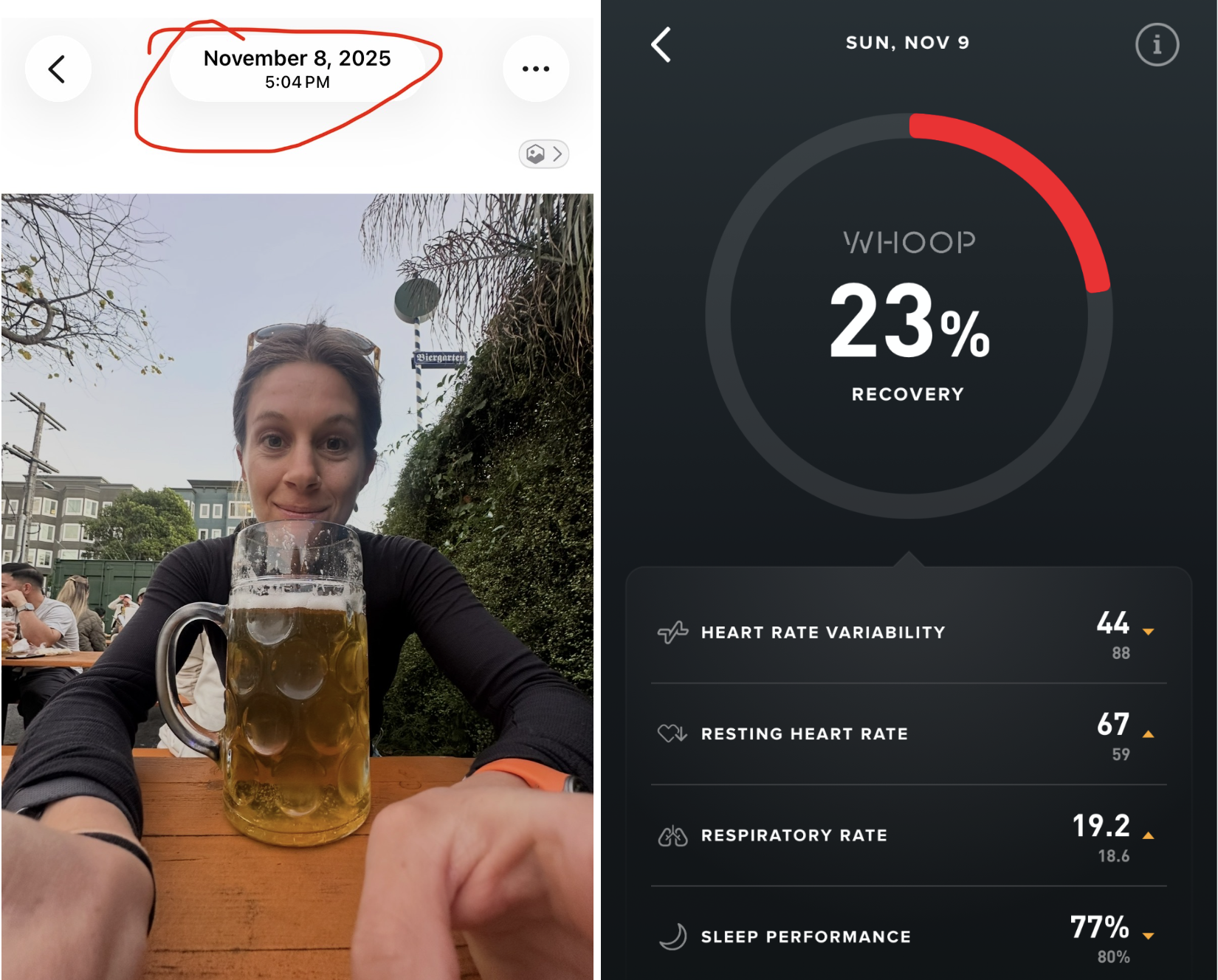
Some things VERY reliably affect my recovery, with alcohol being at the very top of that list. I don’t drink often so even one drink can tank my HRV and RHR. The above shows the effect of "one" drink paired with a few days of bigger training. Because I know how this affects me, I can plan training the next day accordingly, and when I chose to drink, I don’t get too concerned if my data is off in the morning. This is where knowing your body is helpful for interpreting data and making smart training and recovery choices based on how you know will respond to certain training or lifestyle factors. We can still have fun and train effectively, we just need to be smart!
Metrics I Ignore (or highly contextualize):
Recovery Score: It is incredibly common for a recovery score to not match how I actually feel, and I tend to ignore the day to day, and focus instead on the following big picture:
- What is my recovery trend for the week? If I have been in the low yellows (under 50%) or red (under 30%) for multiple days in a row or multiple times during a week, I will pay a lot more attention to the score.
- Does the recovery make sense for the training block I am in? If I am toward the end of a volume block and my recovery score is low, well that just makes sense. Training adaptation occurs when we put stress on our body and then let it recover. If that poor recovery continues into my recovery week, that is a different story.
- What does the underlying data tell me, and how does that compare to my baseline? If my recovery score is low, but my individual data points (RHR, HRV, RR) are normal, then I'm not too worried. The biggest red flag is when HRV is down and resting heart rate and respiratory rate are up* - this is a signal that your body is under a lot of stress and is less able to make adaptations and less resilient to sickness and injury.
- How do I actually feel? If my recovery score is green and I have an annoying little message that says “go far today! Push your limits!” and I feel exhausted - what should I do? I might start a workout and see if I feel better, or I will adapt my plan to something different that has less physical or mental strain. I don’t even look at any data in the morning of a time trial or race, because I think we can convince wrongly ourselves that we feel bad if we see that yellow number, even if we are fully capable of pushing hard. Trust yourself!
*Example:
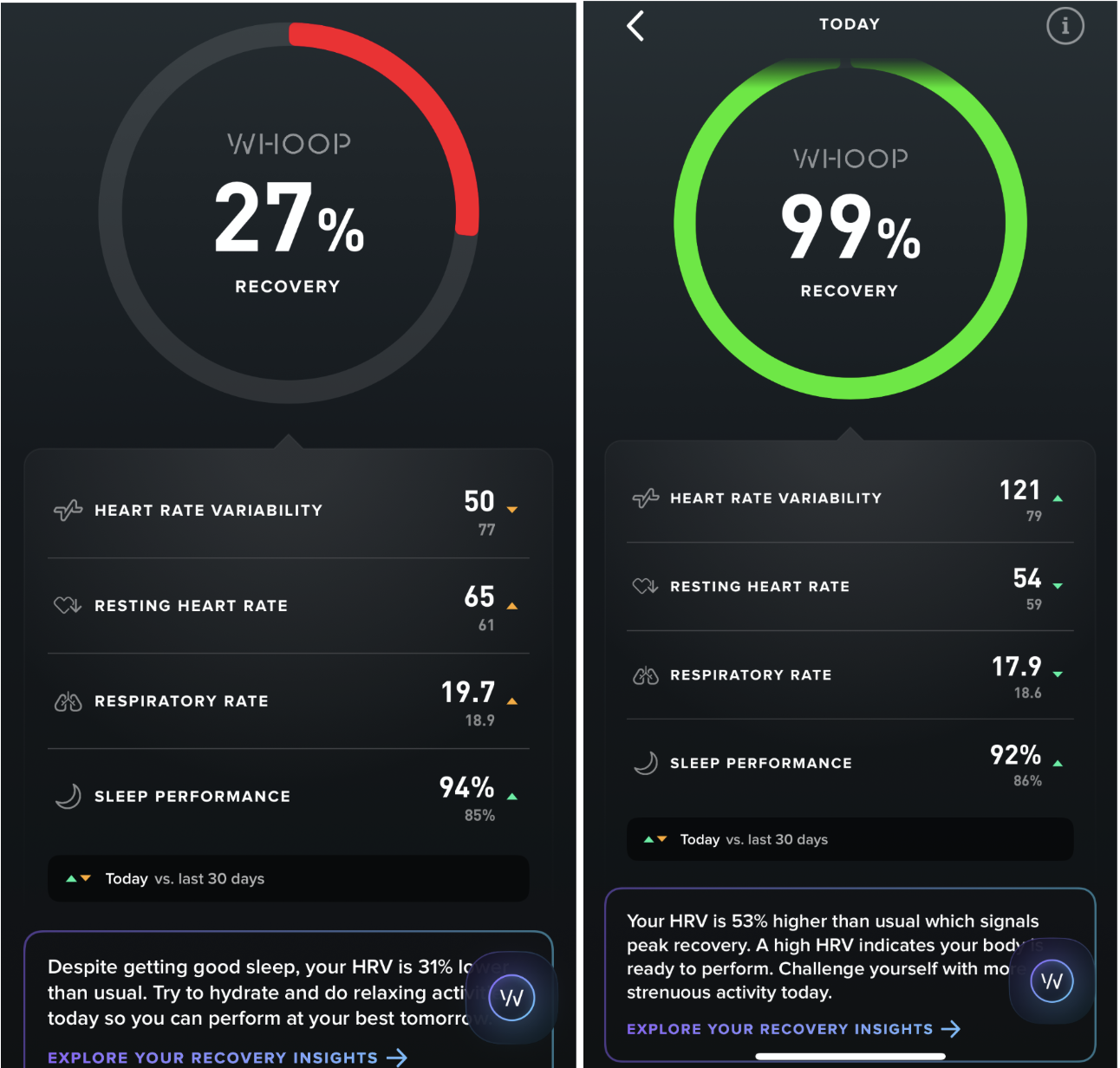
The left is my data from this morning (01/02). As you can see, my HRV is low, and my HR and RR are elevated, despite getting good sleep and training less than usual (recovery week). This is an instance where I put the brakes on and shift from a training mentality to a recovery/preventative mentality. Instead of a long ski and strength, I did a short ski and yoga, keeping gentle movement in my day but keeping the intensity low. The right shows what a 99% recovery looks like (all metrics green!) compared to a <30% recovery.
Calories Burned: At one point, as an experiment, I wore an Oura Ring, a Whoop and a heart rate strap and compared the data across all devices. By far the biggest data discrepancy was in calories burned - with ranges up from 200- 600 calories difference depending on the data source. I use this example because so many fitness devices also come with harmful narratives about what metrics actually matter and push us towards tracking things like weight, calories, and lean body mass that are less useful for measuring fitness and recovery than other data points. I will take a cursory glance to get a general idea of how much and what type of fuel my body needs to recover (most people underfuel). Other than that, I find this metric does more harm than good, and I know it generally undercounts how much fuel I actually need (e.g. smartwatches can't accurately account for the extra energy it takes to stay warm in the cold, and other environmental or individual physiological factors).
*VO2 Max Estimates: A lot of watches will give you a VO2 Max estimate. VO2 Max is the maximum amount of oxygen your body can use during intense exercise and a higher VO2 max is generally associated with better fitness, endurance, and even longevity. However, the only way to accurately measure VO2 is in a lab, exercising to maximum effort while wearing a mask that measures oxygen inhalation and exhalation. Most of us do not have access to a lab, and therefore, the number we are seeing on the watch is not accurate. Most watches also do not account for altitude, which makes it harder to deliver oxygen to your body for the same intensity as sea level.
For the average recreational and competitive skier, VO2 max is less important overall than having a high aerobic base, good economy (technique efficiency), mental toughness, lactate management, muscular endurance, and adequate fueling, hydration and rest. Yes, the best in the world have crazy high VO2 max, you don’t need a sky high number to be competitive. Again I’ll use myself as an example - my VO2 is high for my age and gender, but otherwise relatively unremarkable for an “elite” athlete. However, I have a high aerobic base, I can efficiently clear lactate in my Level 2-3 zones for a long, long time (why I'm a marathon skier and not a sprinter) and I am mentally comfortable with being uncomfortable.
* I do use lab based results to measure VO2 max, I just don’t use the estimates on my devices, and again, I use it as a guide, not as gospel.
~
In Summary:
At this point in my athletic career, I can tell you my heart rate within a few bpm, based on how I feel during exercise. That is because I have spent over a decade training with a heart rate monitor and paying attention to how I feel at each heart rate. The key here is paying attention. If we just blindly follow our devices, we don’t actually learn anything; we have to be actively curious about what data points mean (or don’t) during training and recovery before we can decide which ones are valuable to keep track of. What are your priorities? What are you trying to learn about yourself?
I’m not trying to paint a negative picture of training and recovery devices. Rather, I am advocating for using them as one tool among many, and not getting caught up in the hype around letting data control your life. Data without context are just numbers. The key to using your data effectively is being intentional about what metrics to use and how to apply them to inform your training. Data trends are more important than singular data points, so consistently tracking metrics over time is the most useful way to gain insights and make meaningful changes.
We are not robots after all, and the body is far more complex than a wrist watch can understand. Your watch can’t measure grit or ambition. Your Whoop can’t measure muscle soreness or injury. Your Oura can’t measure tenacity. Your Apple Watch can’t measure technique improvement. Your heart rate monitor can’t measure mental fatigue or joy. Data can offer us some good insights into how our habits and training affect us, but at the end of the day, you know your body best and trusting your intuition is a powerful thing.
questions? shoot me an email AnnikaL@enjoywinter.com