
Posted by Jack Young: EnjoyWinter Athlete Force on Jan 9th 2026
Failure in Val di Fiemme and a Quick Olympic Update
cover photo cred: Leann Bentley
This past week, I ended the Tour de Ski on a sour note. I was not able to achieve my goal of qualifying in the classic sprint in Val di Fiemme due to a combination of skiing slowly and breaking a pole strap causing me to lose a pole 100 meters from the finish. I decided not to do the hill climb and finish the tour, for that performance sprinting led me to believe I was more tired than I realized and another hard distance effort would have just put me more in the hole without any real training benefit being acquired. My performance in the classic sprint and the subsequent decision to drop out of the tour was quite disappointing, but it gave me an opportunity to refine my skills involving dealing with failure.
Going back to the beginning of the season, despite not being satisfied with my races in Ruka and Trondheim, they were still “good” races for me. Comparatively, the classic sprint in Val di Fiemme was the first important race of the year for me that truly went badly. With this being said, it is a great opportunity to take you readers through how I try to handle failure as productively as possible in a way that only makes me better for future races. Of course, handling failure entirely productively is easier said than done (you’ll see soon that I’m far from perfect at it), but I like to think I have an ideal process that I would do if I were to approach failure perfectly. In order to demonstrate this, I thought I would lay out what an ideal approach looks like and then tell my story and compare the ideal scenario to how it actually shook out.
In a perfect world, as soon as I finish a disappointing race, I get as far away from the live results feed as possible and think about what went right and what went wrong. It’s a lot easier to think about what went wrong after a bad performance, but you need the good things too, lest you forget that you had small successes within a greater failure. After hopefully 10-15 minutes of walking around, getting a snack, and putting some warm clothes on, I would then look at the results simply because I’m curious.
After biting the bullet and confirming what I assumed about the bad day I had, it is time to start cheering myself up. This is not done for performance reasons. This is simply done to try and be a little happier and more comfortable for the rest of the day. Dwelling on negative emotions tied to performance all day is not productive. Eventually after hours have passed I would make a simple t-chart listing out what went well and what went poorly. If there are things that went poorly that I can control, this reflection will serve as the basis for changes I will make in the future in hopes of succeeding the next time around.
Sadly, the story of reflecting on this race starts before I even reach the finish line. I’m not proud to say this, but when I heard Jules Chappaz skiing up on me from 15 seconds back at the top of the course, I had already realized I was having a sub-par day. This was a poor mental effort on my part. Chappaz could have been having the qualifier of his life, or maybe I could have pulled back time on him over the top of the hill into the finish. It can be tricky sometimes—especially in cases like this–but something I want to work on is staying in the moment and focusing on what I can control. Instead, in this instance, I focused on how much time I was losing to someone who I want to be close with in a qualifier. This was the start of my post race reflections, but in an ideal world, I would have avoided this.
After this episode (it probably only spanned a couple tenths of a second) I descended the hill well, broke out of my tuck, and promptly broke a strap that caused me to ski the last 100m meters with one pole. I finished the race as best as I could, and then, the real reflection on a bad race started:
Immediately, I was disappointed. Chappaz crossed the line only a few seconds after me which confirmed what I already knew: I hadn’t skied very fast. This data point then led me to start dwelling on all of the parts of the course I felt slow or at least convinced myself I was slow. I skied the transitions on the small hills sloppily, simply felt slow on the big hill, and was incredibly sluggish in the transition section at the top of the big hill. Even though I was filled with negative emotions in the finish pen, I’m actually happy with my thought process over these few minutes. At that moment in time, the mistakes I made and the way my body felt on different sections were as clear as they would ever be. Most of my coaches throughout my life have preached having a short memory about bad performances, and this is true–to an extent. As soon as dwelling on a failure begins to hinder a future competition, the dwelling becomes unproductive. However! Some dwelling is necessary and I would argue even crucial. Of course, the finish pen is not the place to fully flesh out what caused you to fail, but solidifying what went poorly as soon as possible can lock in important memories for when you do reflect.
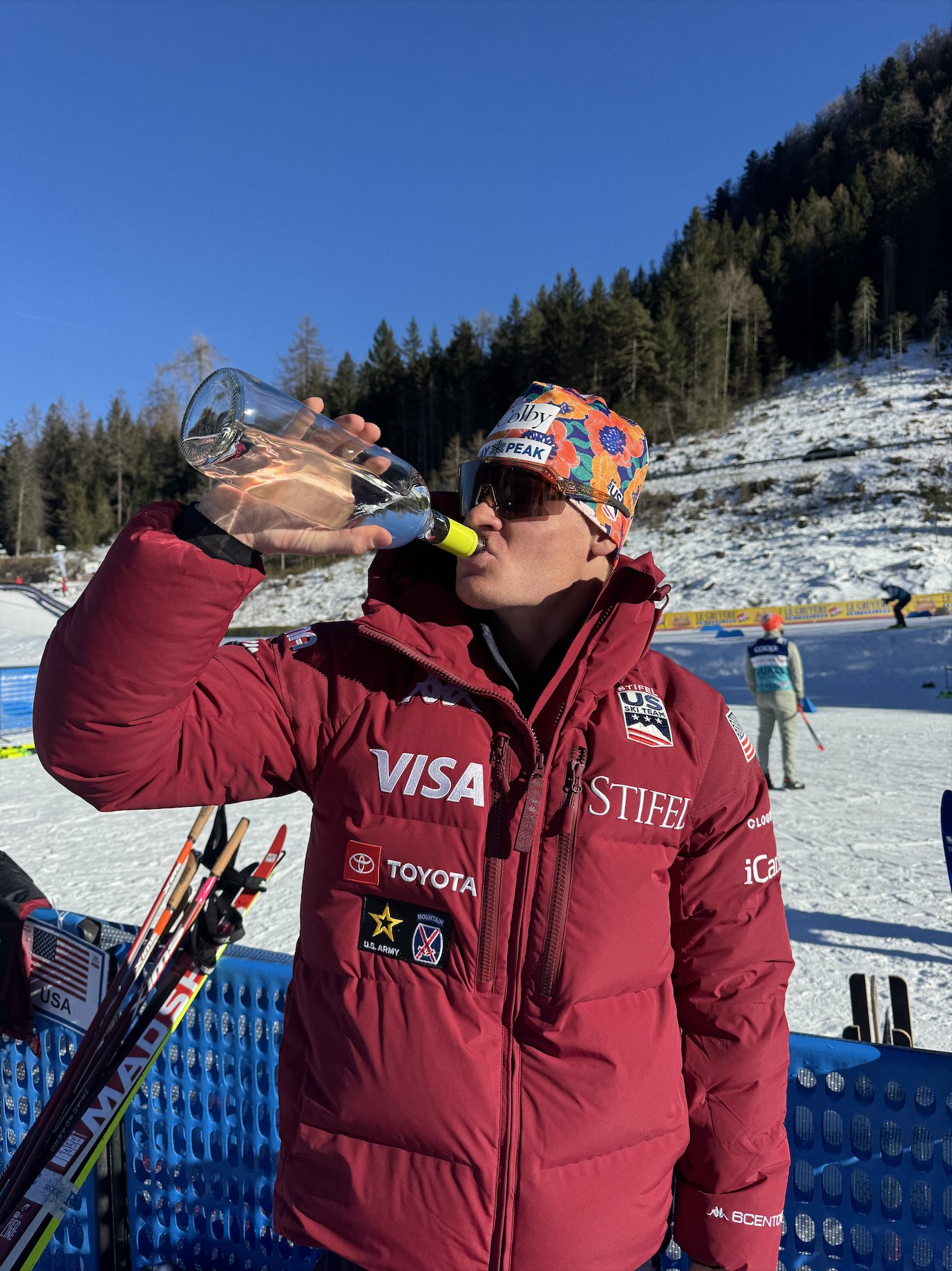
Backwards miracle? Wine to Water
My initial reaction to the race was pretty productive, for I think I was able to nail down exactly what went poorly. My mistake soon after was to start dwelling on the long term implications of this performance instead of trying to start letting it go for a bit. As I’ve explained in prior posts, this race meant a lot in terms of Olympic starts. It is far from cut and dry how the coaches select athletes for races, but proving that I could qualify on this course would have gone a long way. Along the same vein it was also creeping into my mind that I had four teammates who will likely be on the Olympic roster qualify very well. With there being four starts available for each olympic event, I was starting to feel bad.
It would have been hard to avoid thinking about the long term implications of this race, but I would really have liked to avoid it if at all possible–especially so close to the end of a race. This was one of those things that was far out of my control at the moment and giving energy to thinking about it did no good. This is especially true because in no way were the Olympic starts actually decided on that day. I was letting my emotions get the best of me acting as if all hope was lost. Meanwhile, I should still have been either finding the little things that went right and wrong, or if that thought experiment was exhausted, simply moving on to trying to cheer up.
After my first 30 minutes of gloom had passed, I found my first silver lining of the day. I had scored better FIS points than last year (on the world cup FIS points are a decent objective measure of success because they are simply a calculation of percent back of Klaebo) despite feeling much worse about the effort than I did last year. This cheered me up a good deal because it reminded me that I hadn’t for some reason woken up this morning and lost any progress I had made in the last year. Additionally, I brought my thoughts back to the broken pole. I am assuming I wouldn’t have qualified anyway even if I had both poles through the finish, but knowing that I would have been right in the mix if I had stayed clean made me feel a whole lot better. I’m glad I was able to avoid blaming my entire performance on an equipment malfunction only 100m away from the finish, but as I was trying to cheer myself up, it was good to remind myself that not everything that made me slow that day was actually my fault.
The rest of the day went off pretty uneventfully. I decided with Matt Whitcomb that it was best if I didn’t finish the tour, and I stayed and watched some of the sprint heats at the venue. The last step, arguably the most important step of reflection on my performance that day, would come later in the evening. That night, I sat down in my hotel room and made a t-chart in the notebook I keep on hand for this exact reason and listed out what went well and what went poorly:
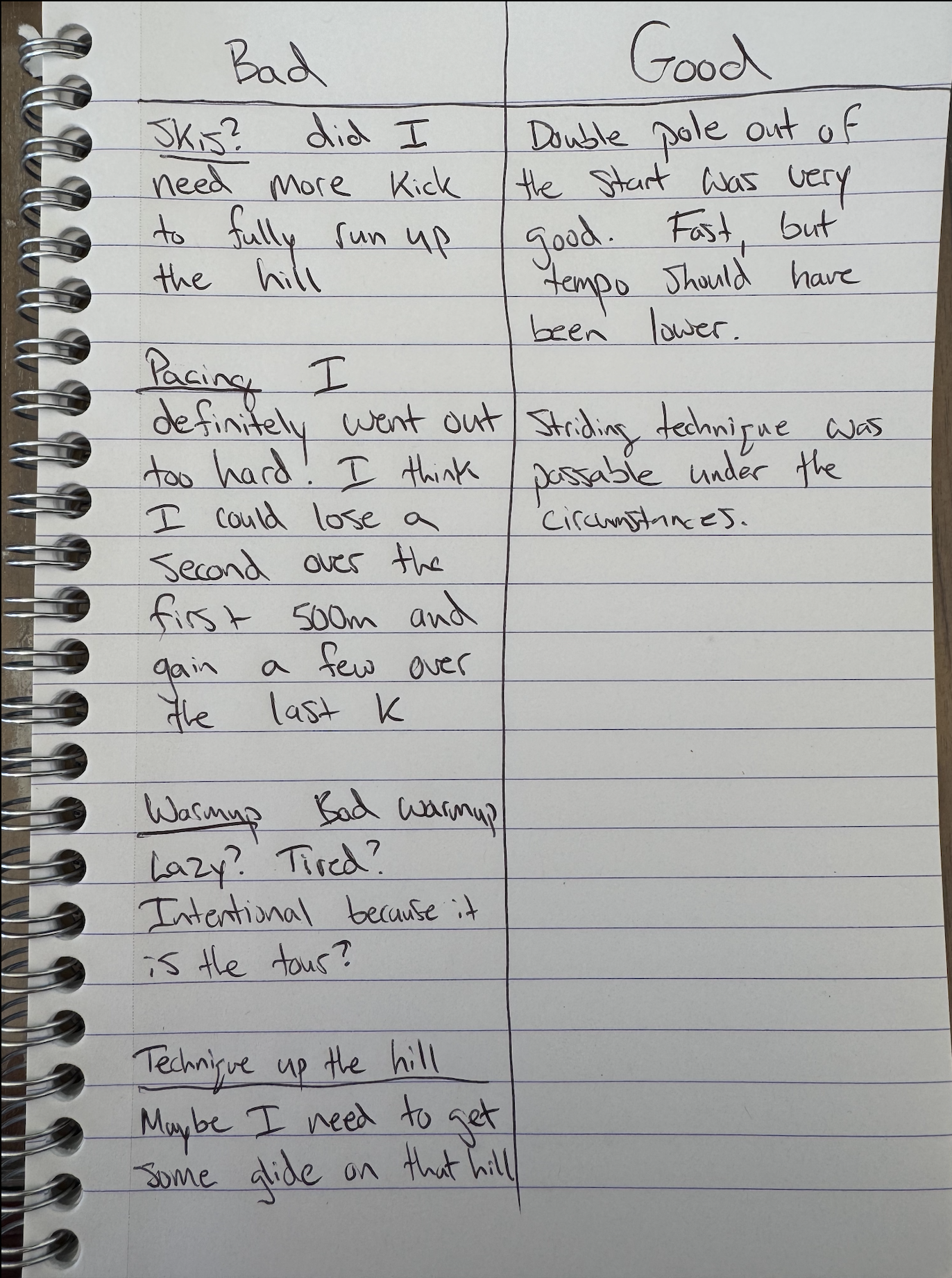
my chart from the night of the classic sprint (rewritten verbatim because my handwriting was illegible.)
An important distinction between this step in the process versus the earlier ones is that this one is not just gathering information or dwelling on failure. This chart is the first step in the process of figuring out how to get better and not fail the next opportunity I get. I have no idea whether I am going to get another shot on that course, so in my mind the next really important race is the world cup classic sprint in Goms. This is the last sprint before the Olympics begin, so it is my last chance to show what I am capable of. I like to think I can get better at the process of learning from failure, but the process doesn’t need to be as drawn out and complicated as I described in this post. In my mind what is important after a bad race is identifying what went wrong, figuring out which of those things you can control and to what degree, and figuring out how to do those things better next time around. If you can do all this while also figuring out a way to cheer yourself up in the process, you’re doing pretty damn well.
Coming off of the tour, the question is again how can I qualify for a world cup classic sprint? The short answer is that I need to figure out a way to relax during the first half of a longer classic qualifier while not losing much time so that I can move like I know I can up big climbs later in the race. This, of course, is an oversimplified answer, but I haven’t put too much thought into the training plan yet. Right now my focus is on relaxing and recovering, and I’ll get into the weeds of writing the training plan next week. For now, I can sleep easy knowing that I have clearly written out exactly what needs work.
A Quick Olympic Update:
Barring something strange and unforeseen happening, I am in for the Olympic team. However, I have lost ground in my goal for getting the start in the classic sprint. If the Olympic sprint starters were decided with no more data, it is very likely that the lineup would be Ogden, Schumacher, Schoonmaker, and Ketterson. This being said, it is not guaranteed that every athlete will accept every start they get. In the end, it's hard to know where I stand, but I have a very clear path through the Goms classic sprint of improving.

Seefeld!