
Posted by Patrick Campbell, Enjoy Winter Ambassador on Feb 5th 2026
Completing the 53rd 70km Marcialonga in a Snowstorm (Bib 6001)
The Idea Takes Shape
The idea started over a casual summer conversation. My wife and father-in-law were reminiscing about downhill ski trips to Italy when she was a kid—staying at the now-defunct Hotel Montana in Pozza di Fassa, just a hundred meters from what I would later learn is the Marcialonga trail. There were stories of the terrifying Vigo di Fassa cable car, and of my wife breaking her leg on Alpe Pera at the age of eight.
Knowing I’m a devoted cross-country skier, my father-in-law—perhaps jokingly—suggested that we all go back the following winter, and that I ski the Marcialonga. I didn’t know much about the race at the time, but I said yes almost immediately.
We quickly looked at flights, assuming they would be prohibitively expensive, and found some that were too good to pass up. The next thing we knew, I had signed up for the Marcialonga (worried that registration would fill up, as it does every year with 7,000 participants plus another ~500 in the 45 km race), and we had bodoked flights for my wife and me and our three boys, who also cross-country ski with the Bill Koch League and in high school. Little did we know, this was the easy part.
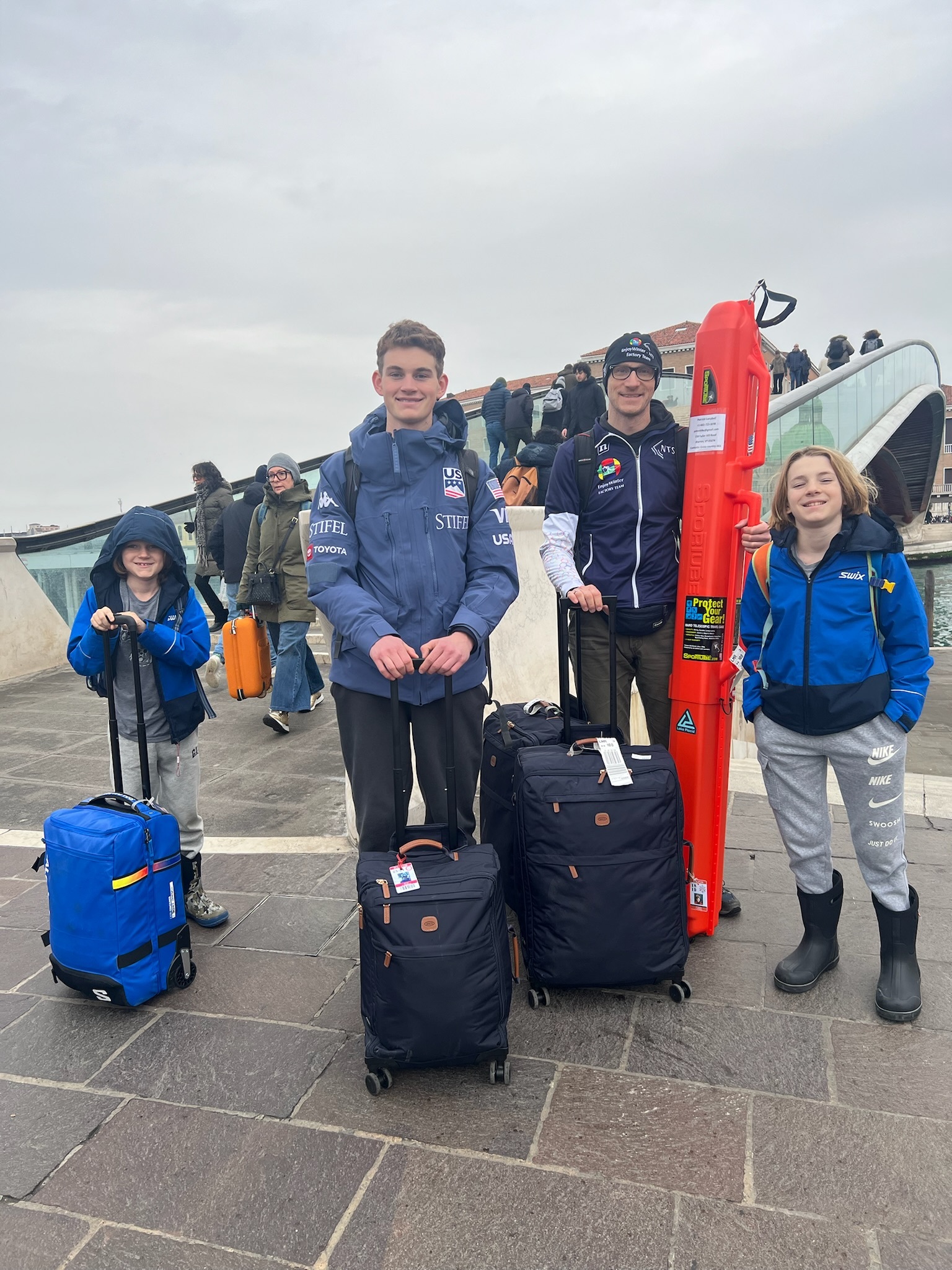
Arrival in Venice with all of our gear, skis intact!
Eight Months to Prepare
My wife and I worked through the logistics together: hotels (one near the Venice airport, one in Moena, where the Marcialonga starts), figuring out how to bring cross-country skis on a plane without destroying them, and finding a rental car in Italy big enough for a family of five, our luggage, and at least one pair of skis and poles. Questions about race-day fuel and access to the start would follow us right up until we arrived in Italy.
I signed up for the Marcialonga on June 3rd. I had about eight months to train—and to figure out answers to all of those questions.
In midsummer, I reached out to Andy Gerlach at EnjoyWinter.com, who suggested a pair of Swenor Fibreglass rollerskis. They have a nice flex and ride much smoother than aluminum on our variable Vermont pavement, which seems to be either very good or very bad. I started cautiously in the Sugarbush parking lot (where Green Mountain Valley School sometimes trains), then worked my way onto roads, avoiding downhills as much as possible—they still scare me. On vacation in the Outer Banks of North Carolina, which is pancake flat, I managed a few 20-mile rollerskis, which felt like a small victory.
All summer and into the fall and winter, I trained by running partway up Sugarbush work roads, roller skiing, and spending a lot of time sweating it out on the SkiErg in the basement. Knowing that the pros double pole the Marcialonga (no kick wax), I wanted to try to do the same. Not long before we left for Italy, I finally ditched my skin skis and started straight double poling our local trails—finally on snow. It felt easier, and I was noticeably faster. I knew I was ready for the race, at least physically.
Arrival in the Val di Fassa
We arrived in Moena about five days before the race, and there was a lot to take in. Much of the Marcialonga trail was already groomed daily and open to the public. Anyone could ski any open section, in either direction. The sections still missing snow were generally those running through village streets in the Val di Fassa and Val di Fiemme—and these would be completed at the very last minute, the night before the race.
What many people might not realize is that the Marcialonga organization is equipped to lay down 100% of the course using man-made snow. Massive stockpiles are staged throughout the valley, and a local construction company, STE, trucks and dumps snow all over the course in the days leading up to the race. It’s an incredible feat, and one I didn’t fully appreciate until seeing it in person.
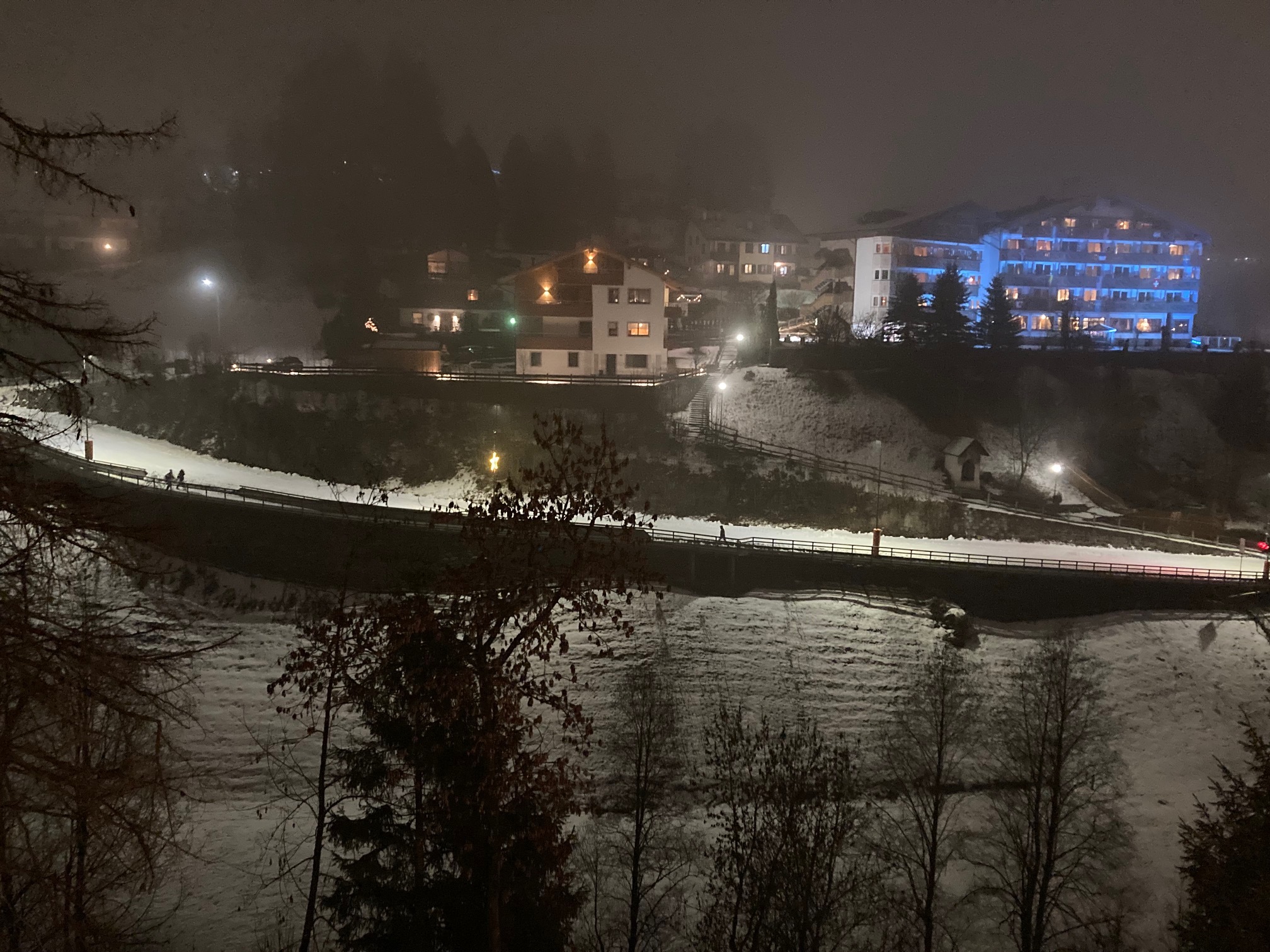
The road behind our hotel transformed into the Marcialonga trail in the overnight hours before the race.
Pre-Race Days: Testing, Waxing, and Small Wins
A few days before the race, we found rental gear for the rest of my family in sunny Pozza di Fassa (I brought one pair of skis and two pairs of poles in a SportTube) and set out for a relaxed 10 km out-and-back on the Marcialonga. We stopped at a local café for a doppio espresso and biscotti before heading back. The tracks were fast and firm, and I started to imagine how quick this 70 km race might be under perfect conditions.
Slowly, answers to some of my lingering questions fell into place. On Saturday, all three of our kids raced in the Mini Marcialonga and Marcialonga Young events in Pozza di Fassa, in a festive atmosphere with music, food, drinks, swag, and demo gear. By coincidence, I wandered into the Toko tent and learned they were waxing skis for the next day’s race—and could do mine on the spot. I had been trying (and failing) to wax my skis without an iron or ski vise, and I knew the Toko race crew would do a better job than I ever could. That alone helped me sleep that night.
One thing worth noting: although the Val di Fassa is a major downhill ski destination, we didn’t find many well-stocked cross-country ski shops. Everything we saw was very downhill-focused. If there’s something you think you might need, it’s best to bring it. Breaking a ski, boot, or pole could leave you scrambling.
We also realized that from our hotel in Moena, the race passed directly in front of the building, and I could walk-to-ski to the start in about ten minutes—even after the race had begun. With many roads blocked, this was crucial. As a bonus, the hotel opened breakfast early so I could fuel up on espressos, mini chocolate croissants, and fresh bread.
Race Morning: Snow, Waves, and Mistakes
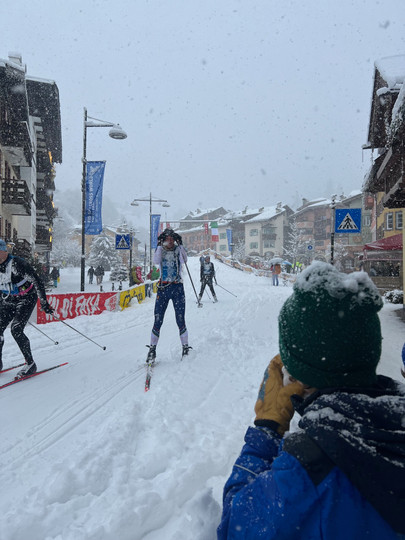
Race morning arrived with thick, wet snow falling steadily and temperatures hovering around freezing. We had expected a little overnight snow that might taper off, but instead it snowed through the night and most of the race. I headed out on my walk-ski to the start far too early.
The Marcialonga uses a wave-start system, and for Americans, races like the American Birkebeiner and the Gatineau Loppet can serve as seeding events to help place faster skiers in earlier waves. I highly recommend taking advantage of this if possible—being seeded can make a huge difference early on.
Without any prior seeding, I was placed in the 12th (!) starting wave, behind roughly 6,000 people. My scheduled start time was around 9:18, but we didn’t actually begin until about 9:30. I arrived at the start around 8:10, which meant a long time standing around getting wet.
Many people sheltered under an overpass or beneath the eaves of small buildings that looked like wax sheds. I had a poncho, but I was soaked regardless. One of my biggest mistakes was not fully anticipating the weather—or just how much traffic there would be. I chose not to wear base layers under my race suit, assuming I’d be working hard enough to stay warm. What I didn’t realize was that with so many people ahead of me, traffic jams would persist throughout much of the race. We even came to a complete stop several times while waiting for people to herringbone uphill or negotiate downhills.
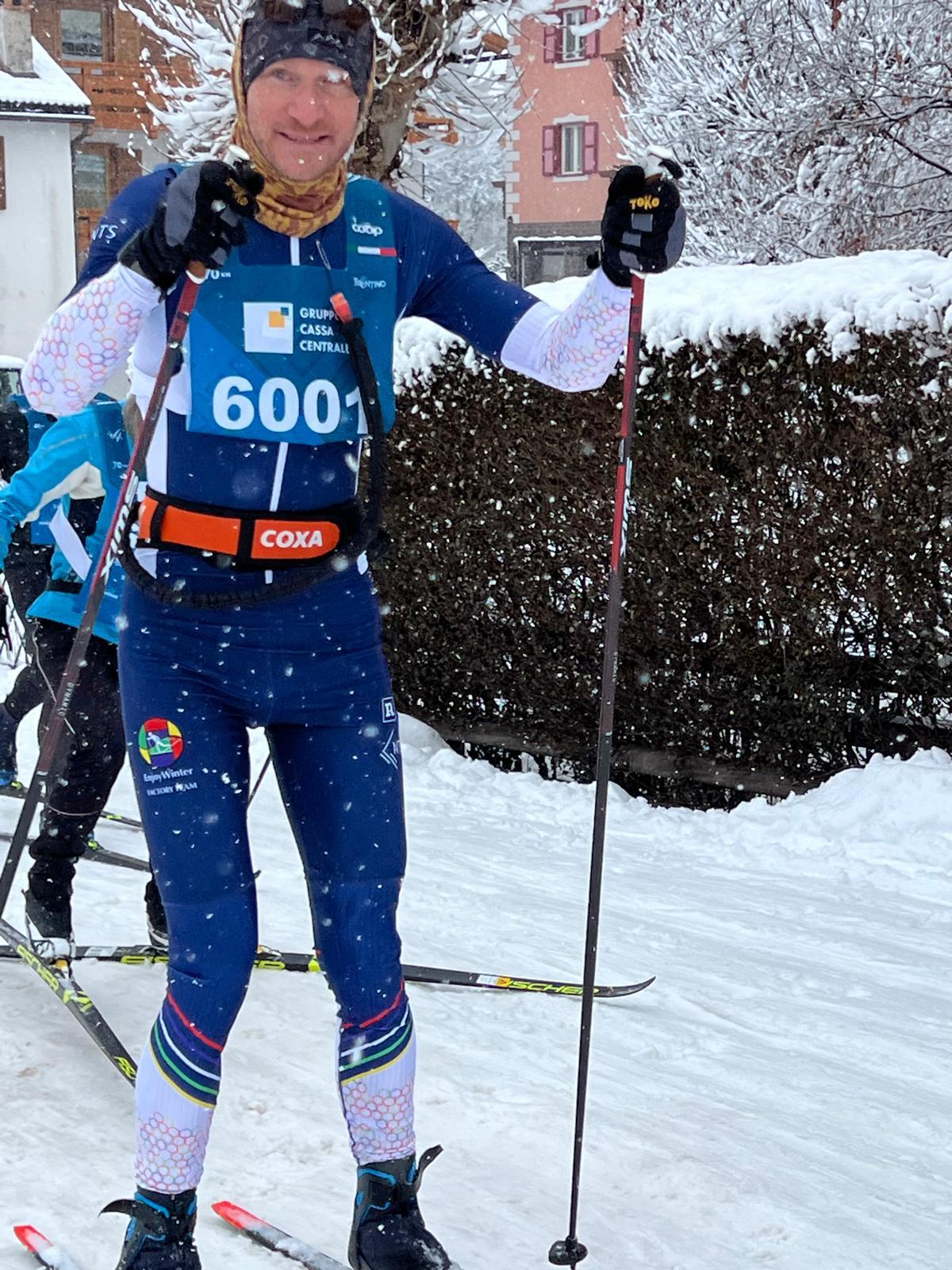
Still smiling in the first few kilometers.
Into the Traffic
The congestion was made worse by the snow. What is usually a two- or three-lane trail narrowed to a single track in many places. Early on, many people removed their skis on downhills to avoid pileups, and I followed suit. I’m not sure it was faster, but I avoided breaking a pole, so maybe it paid off. Others weren’t so lucky.
Traffic stayed thick from Moena to Canazei, and for much of the return trip to Moena at the halfway point. I was able to pass many people who stopped at early aid stations for Enervit, Loacker wafers, chocolate, or blueberry soup by carrying my own fuel in a Coxa WR1 drink belt. I’d seen pros using the Coxa in other races, and it holds about 44 ounces—enough for roughly two hours in cold conditions. That said, the aid stations are plentiful, extremely well staffed, and efficient. If you pull in, someone hands you a drink almost instantly. After running out of my own fluids, I relied on Enervit, which was easy to stomach and tasted similar to Gatorade.
Cold, Slow, and Questioning Everything
The Marcialonga turned into a cold, slow, wet slog. I was chilled to the bone and seriously considered quitting more than once. I was saved at the halfway mark in Moena, where my sister-in-law took the mittens off her own hands and gave them to me so I could finish.
From there, I found some momentum. I passed people herringboning short climbs by double poling around them—although this strategy backfired once, when I slid off the side of the trail into deep snow.
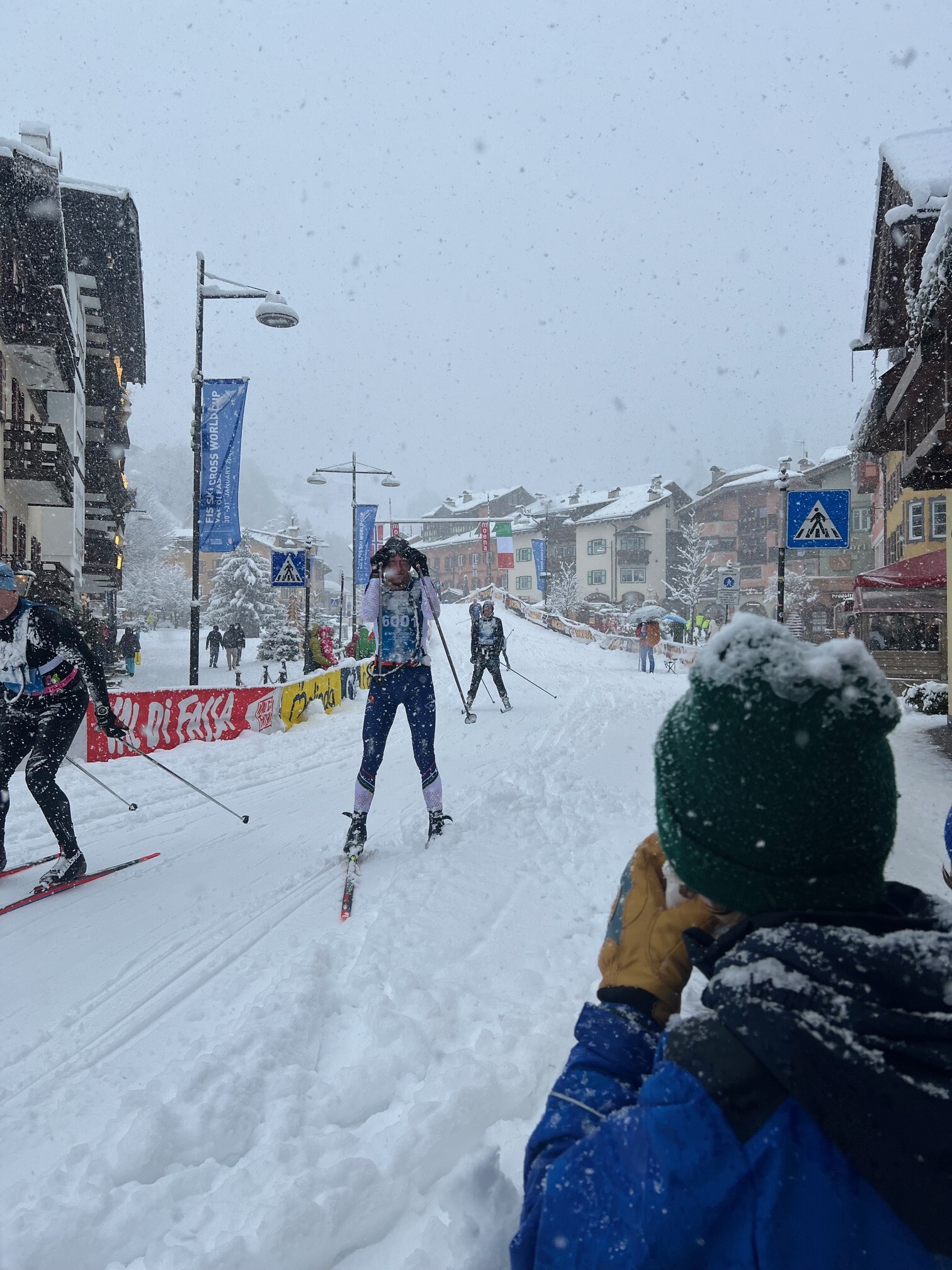
Visibility was tricky throughout the race with blowing snow combined with fogged up glasses.
The Cascata and the Klister Miracle
I was saved again at the Toko klister station at the base of the Cascata climb. The Cascata, the final climb of the race, is roughly 1 km long and averages a 10% grade. After more than six hours in the cold, neither double poling nor herringboning sounded appealing.
The Toko race crew applied klister like a NASCAR pit stop. They took my skis off, applied klister, put them back on, closed my bindings, and even asked how their earlier wax job had held up. My double-pole skis have a very hard camber underfoot, and I wasn’t convinced klister would work—but it did. With some light stomping to engage the wax pocket, I was able to ski the entire Cascata climb in parallel.
An Unforgettable Marcialonga
This turned out to be a Marcialonga of epic proportions. The pros finished roughly 45 minutes slower than usual—one of the slowest editions on record. Volunteers and supporters endured wet snow for hours longer than expected, and more than 1,250 additional participants dropped out compared to a typical year. Of the 7,000 registrants, fewer than 3,700 crossed the finish line in Cavalese.
For many of us, simply finishing in these conditions was a huge achievement. I crossed the line cold, exhausted, and soaked through—but deeply grateful to be there at all, cheered on every step by my family.